
Understanding undergraduate university fees in Australia
Remember in 2016 when everyone was freaking out about $100,000 law degrees when Abbott was suggesting that university fees for undergraduates should be deregulated?
Well, that didn’t end up happening, if you are starting university in 2017, it might be helpful to know what you will pay, and what the government pays, for your university education. And how we compare as a nation on the global stage.
We are lucky to have, at least for now, a pretty good loan system for students so that, in theory, higher education is available to all regardless of their socioeconomic circumstances.
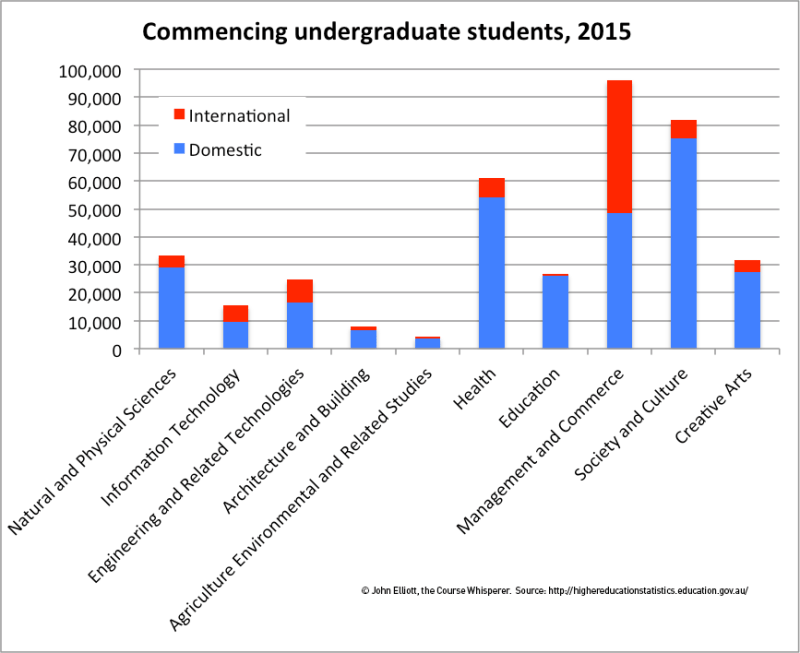
In 2015, the last year for which we have higher education statistics, over a quarter of a million Australians commenced a bachelor’s degree. This is more than any other year in Australia’s history. They were joined by 85,000 international students, more than half of whom commenced commerce and management related courses. See the chart below for details on what people were studying (note these are based on broad DET classifications which, unhelpfully, don’t match HECS funding clusters).
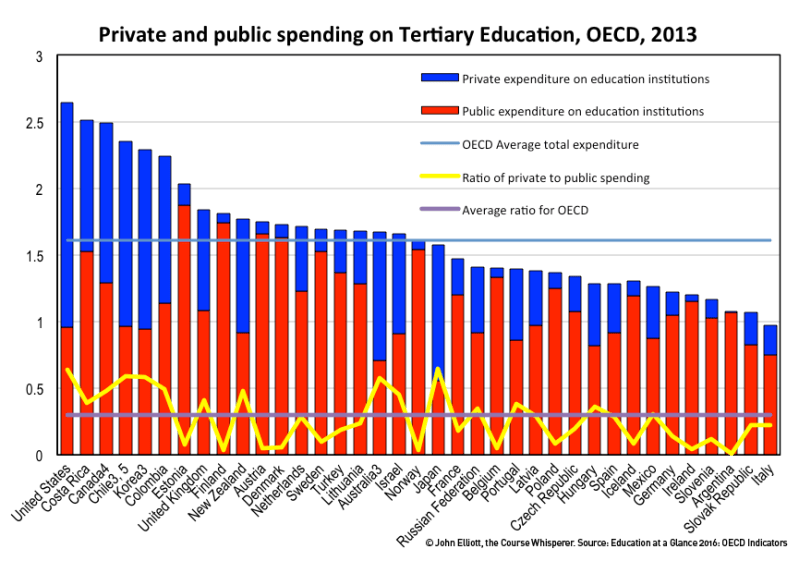
Those 85,000 international students help to bankroll what would otherwise be a chronically underfunded higher education system in Australia. How low is government funding per student? Well at 0.7% of GDP, government funding for higher education is well below the average in the OECD (1.1%) and is above only Japan, which has an ageing population and hardly any people left of university age.
The chart below (I like charts) shows the level of private expenditure in tertiary education, and Australia is well above average for that, and the ratio of private to public spending, which is higher in Australia than for all but the really big spenders in tertiary education. Bottom line is, the government is paying less for your university education than just about anywhere else where you would like to live. (slight caveat here, since 2013, the UK has shafted its students by raising fees to the point where they are now over £9000 per year)
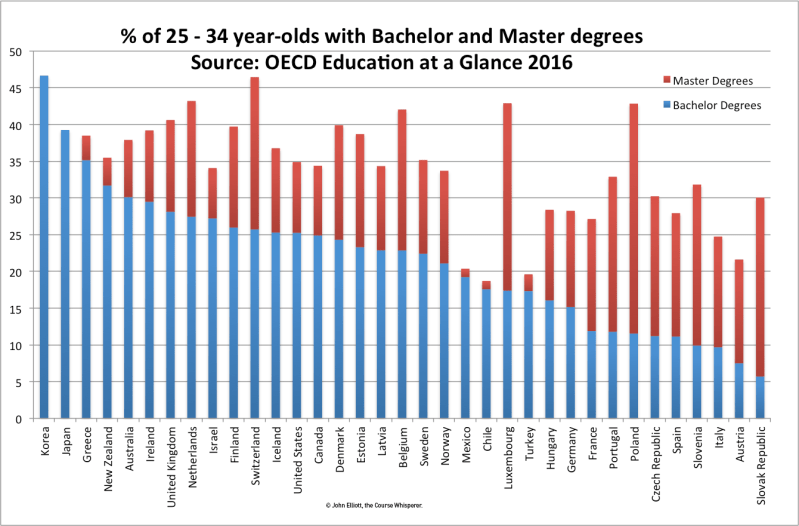
Remember when we were aiming to be the clever country? It is even more depressing when you realise that we rank 4th in the OECD for the percentage of 25-34 year olds with a Bachelor degree (which are publicly funded, at least in part), and 11th for those with both a Bachelor and Master (which are largely privately funded) degree. All up over a third of Australians are heading off to university. See the chart below for details. So if we are pumping out more graduates than average, but spending less, either our universities are super-efficient, or the quality is lower, or the money is coming from somewhere else (you, and international students).
However, this is only half the story, because what you pay, and what the government pays, depends on what you study. Your HECS contribution depends on the cluster in which your subjects sit. There are three broad price bands that you will pay per full-time year:
- $6349 (humanities, teaching, social studies, psychology, performing arts, languages, nursing)
- $9050 (mathematics, science, built environment, allied health, engineering, agriculture)
- $10,596 (business, law, medicine, dentistry, veterinary science)
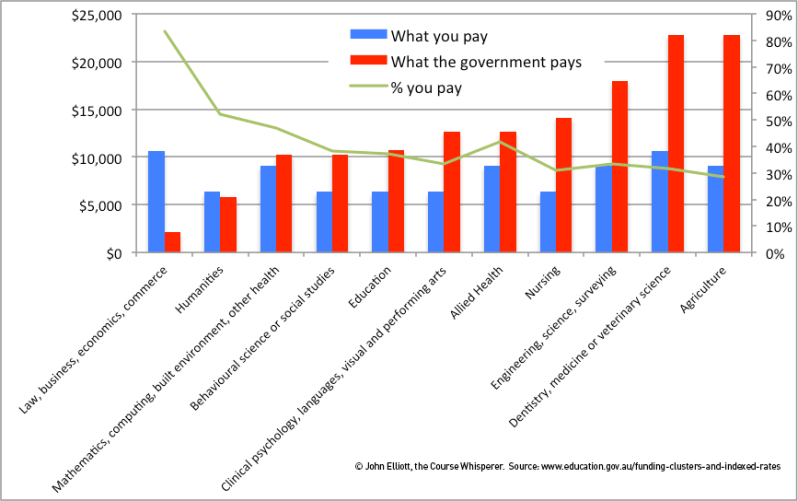
Every subject taught at university has to fit into one of 11 clusters. So if you are studying business or law, you pay $10,596 in 2017 (assuming you do a full-time load), more than every other type of student except medicine. However, whereas the government contributes an additional $22,809 to universities for each medicine student, they only add another $2089 for business and law students. This means business and law students fork out 84% of the funding that the university gets for teaching them. The next highest ratio of student to government funding is for humanities, and that is at 52%. Check out the chart and table below, or visit the government HECS website for full lists of subjects.
| Cluster | Description | What you pay (2017) | What the government pays | Total funding to the university | % you pay |
| 1 | Law, business, economics, commerce | $10,596 | $2,089 | $12,685 | 84% |
| 2 | Humanities | $6,349 | $5,809 | $12,158 | 52% |
| 3 | Mathematics, computing, built environment, other health | $9,050 | $10,278 | $19,328 | 47% |
| 3 | Behavioural science or social studies | $6,349 | $10,278 | $16,627 | 38% |
| 4 | Education | $6,349 | $10,695 | $17,044 | 37% |
| 5 | Clinical psychology, languages, visual and performing arts | $6,349 | $12,641 | $18,990 | 33% |
| 5 | Allied Health | $9,050 | $12,641 | $21,691 | 42% |
| 6 | Nursing | $6,349 | $14,113 | $20,462 | 31% |
| 7 | Engineering, science, surveying | $9,050 | $17,971 | $27,021 | 33% |
| 8 | Dentistry, medicine or veterinary science | $10,596 | $22,809 | $33,405 | 32% |
| 8 | Agriculture | $9,050 | $22,809 | $31,859 | 28% |
This funding not only impacts you and the amount of HECS debt you will have to pay back once (if) you start earning over $54K (see the Study Assist website for details), but the total funding that the university gets for teaching you. This in turn dictates how students are taught, including class sizes, teaching resources, teaching modes and more. It allows universities to invest more per student in courses that are resource-intensive, which is great, but also restricts the amount of resources that can be given to some subjects. And it encourages universities to rely on international student income to a higher level than in any other country. International students don’t get subsidised at all by government funding, and pay up to three times what you pay for an undergraduate education.
Because the pain of paying for your education is deferred, you are less likely to think too much about it, but you should. You should also think about how much, or how little, your education is subsidised, and whether the public benefit of your education outweighs the percentage you pay.
Whether university education is a good investment for you (it most definitely is) is the subject of another article but you should definitely get your head around the investment first.
Happy studies.
 The Course Whisperer
One thought on “How much are you paying for university?”