
Around the beginning of the year, students and potential students start to make big decisions about not only which course to do, but whether they should go to university at all.
Here’s the quick answer: you should. Not only is it a good investment for you, it is a good investment for society.
What is the investment?
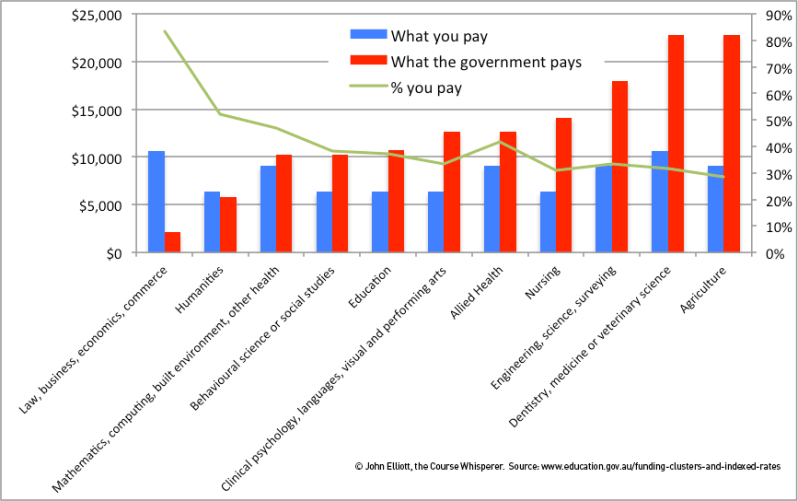
If you are talking undergraduate, you will pay between $6500 and $11,000 per year for Australian residents, depending not on the uni you go to but the HECS cluster you are in (see an article that explores that in more detail). But that is only part of the investment. You will need to buy study materials from text books to lab equipment, pay for administration and amenities (about $150). If you are from a regional area you may need to fund accommodation or a residential college (with potentially expensive legal fees for participating in some horrendous out-dated misogynistic hazing ritual).
I know you also need to factor in travelling to uni, coffees, meals, no-doze *snark* etc, but you would be eating and drinking anyway (OK, maybe not that much drinking), and you get concession rates on travel, so let’s not split hairs here.
The big cost is the opportunity (or real) cost of not working. If you are spending 12 to 15 hours per week at uni, plus double that for study, group work, assignments, readings etc, that equates to a 36 to 45 hour week – roughly the same as a full-time job. So what could you be earning working full time?
Let’s assume you are earning minimum wage, which is fair enough as if you are 18 and not studying you don’t really have that much to offer in terms of skills sets.
An 18 year old will earn $12.09 per hour (not counting casual loading of 25%). So working that out to a salary you get a smidge over $22,000 per year. Once you hit 19, you earn $14.60 per hour, so your salary rockets up to $26,570 per year. And at 20, you earn $17.29 per hour, or $31,468. So for the three years you are working instead of studying, you could earn just over $80,000 minus tax. That is a big opportunity cost for going to university. But this also assumes when you aren’t at university you are just either studying, socialising or sitting at home wasting time reading articles like this. Many students don’t do that. They work. In fact almost 60% of students work either part or full time while studying. So if you managed to work for the equivalent of half the year this halves the amount of lost income you need to make for by going to university.
So let’s say, for the average Australian, an investment in going to uni, including fees and opportunity cost, will sit somewhere between $60,000 and $75,000. This equates to around 2 years at one of the country’s most expensive private schools. It will also be around half the deposit you will need to buy a modest apartment in Sydney (or a 4 bedroom home in Brisbane).
So is this a good deal? Let’s look at the return on investment.
In 2015, the median starting salary of graduates in Australia aged under 25 was $54,000 (and preparing females for a lifetime of salary disparity, male graduates average $55,000 while females average $53,000).
Going back to the minimum salary figures, for a 21+ year old (the average age of someone finishing a three-year degree) is just over $32,000. So in theory, you could be able to earn around $22,000 per year more if you have a degree. Now I know not everyone earns minimum wage. And I know you can start your own company, be your boss and all that (but most fail, especially if you don’t have any essential knowledge about markets and skills to deliver what they want). But ignoring all of that, it would take you at most 4 years of post-university working to get a positive return on your investment. Over the course of your career, you can expect to earn $2.9 million if you have a bachelor degree, compared to $2.07 million for someone who finished year 12 (see http://www.abc.net.au/news/2012-10-24/uni-graduates-likely-to-earn-one-million-more-over-lifetime/4330506).
Sure everyone knows someone who dropped out in year 10 and made millions, but they are the exception, not the rule.
Of course, there is also the concept of subjective wellbeing, and a 2011 NATSEM paper identified that “the more educated of the younger age group are still more satisfied with their finance and health than the less educated of their age group” (source: NATSEM http://www.natsem.canberra.edu.au/storage/WP12%20Final%20for%20Web.pdf, page 16). Interestingly this correlation drops away with master and doctor-levels of education, but this might be because after spending 6 years becoming the world expert in the minutiae of an obscure topic you realise this doesn’t make you any more employable.
Video blogger John Green put out a great video on how college in America (where it is way more expensive than in Australia) is worth it. Check it out here. In addition to the financial benefits he made a great point that since graduating college he hasn’t had to clean up vomit in a restroom– something that was not a particularly joyful part of his part-time job.
And this is the real reason why university education is worth it. I like what I do, and get to work with really, really smart people. I don’t have to clean up vomit. One of my brothers, who left school in year 10, cuts down trees for a living. He is very good at it, and works very, very hard. Once when I was complaining that during a heatwave I had to loosen my tie even inside my air-conditioned office, he countered that he passed out from heat exhaustion. Up a tree. I am not saying that my brother would choose to do my job. And I am certainly not saying what I do is more important. But what I am saying is that I had a lot more choice of career with a university education. You can do a whole degree then go and do a trade, but it is your choice then.
And the benefit to society?
A range of analysis points to the broader benefit to society in terms of economic inputs (around $5 billion in increased government revenue per year, and a much lower chance of being unemployed) but it is more than just economic. University provides all graduates with a higher ability in analysis and critical thinking. This leads to greater abilities in problem solving. This generates new thinking in key areas that benefit society.
And perhaps most importantly, an educated population is less likely to vote in a despot. Just look at America. Sure, not all of the voters for the new President were dumb-as-shit under-educated rednecks. Some were wealthy white neo-nazi fuckwits as well. But the very loud voice of dissent, those that are calling him and his cronies on the blatant lies, are most loudly coming from those with university education (and by university I mean real university, not private real estate sales University con-jobs). In every totalitarian regime, it is those who are educated that are targeted first as they represent the biggest threat. So education is not only good for you personally, and not only good for the economy. It is good for freedom and democracy.
University education won’t guarantee you a great career, just like doing a trade doesn’t consign you to a life of misery. But it gives you choice, it gives you agency, it gives you knowledge that you will call on for years to come, and it will provide a network of some of the best people you will ever meet.
 The Course Whisperer